
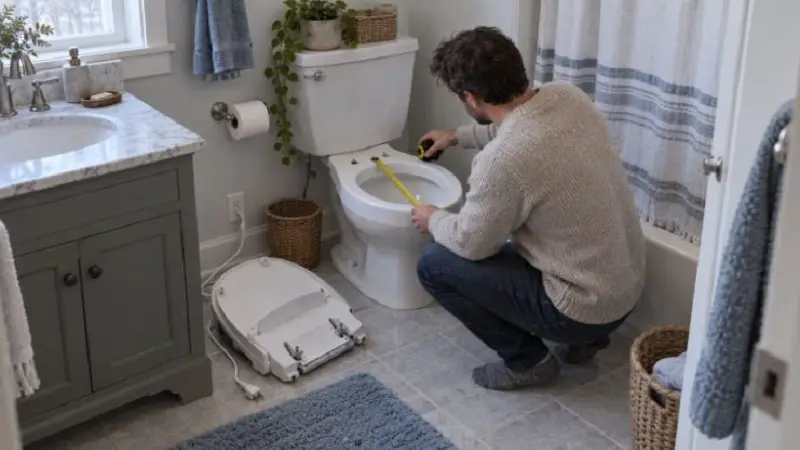
There’s no single heated toilet seat that suits every household. Pick one with the wrong shape or the wrong power requirement, and you’re stuck with a box you can’t install. That’s why this heated toilet seat buying guide for families begins at the bowl. Start there with a tape measure. Once you know the bowl is a match and you’ve confirmed safe power access, you can weigh heating systems, controls, and cleaning demands against how your household actually lives and what you can spend. Trust the installation manual over the product description; one is engineering, the other is marketing.
Start with a heated toilet seat size guide
Identify a round or elongated bowl
Whether you need a round or elongated heated toilet seat comes down to the bowl profile, not to mounting holes that happen to look similar. Stand over the toilet, look straight down, and measure from the centerline of the mounting holes to the front edge. Most fit questions are settled by that one number. A heated seat fits only when its shape and mounting pattern match your toilet and every listed dimension agrees with the spec sheet.
Measure the mounting area
Write down the bowl’s width and bolt-hole spacing first. Then note the distance from the hole centerline to the front rim, plus whatever clearance you have behind the holes. Make a simple top-view sketch and label each measurement so you can compare the same points with the product diagram. Do not rely on a generic standard dimension when the model’s specification sheet provides its own fit range. Even measurements that look fine can fail in practice. A raised tank or an odd curve on a one-piece toilet can block the rear housing or keep the mounting plate from sitting flat against the porcelain.
Check who will share the seat
Check the opening, too. Everyone from kids to grown-ups should be able to sit comfortably and reach the controls. Some models let you limit accidental adjustments; the manual will tell you whether a control lockout exists.
| Fit check | What to record | Why it affects the order |
| Bowl shape | Top-view outline: round or elongated | The seat profile has to follow the bowl rim. |
| Mounting pattern | Distance between bolt-hole centers and rear clearance | The mounting plate needs room to sit securely. |
| Front reach | Mounting-hole centerline to front rim | Keeps the seat from overhanging too far or stopping short. |
Check the bathroom’s power access
Does an electric warming seat require an outlet?
Yes. An electrically heated seat needs the power source it’s specified for, and most plug-in models call for a compatible outlet within reach. Find yours without moving any wiring. Note how far it sits from the toilet and on which side, then compare that against the manual’s cord length and plug position. While you’re at it, check voltage and the other electrical requirements too.
Don’t guess about electricity. An extension cord is not an installation plan. If you’re unsure about the outlet or the circuit, have a licensed electrician assess both, working from the installation manual.
Can a warming seat work without a visible cord?
Active heating needs a specified energy source. A cord-free product must identify another power source or a concealed power arrangement, and if it can’t, it doesn’t heat. A padded or insulating non-electric seat never actively warms its surface, even if it feels less cold than the seat it replaces. Product photos are not proof of cordless operation; confirm the power method in the manual.
How heated toilet seats differ beyond warmth
Separate seat heat from warm-water delivery
Tank and tankless usually describe cleansing-water heating, which is a separate element from the seat warmer. Tanks store a limited amount of warmed water; tankless systems heat water on demand. If a seat has no washing functions, skip that comparison entirely, because it doesn’t apply.
Once fit and power are settled, the decision is mostly specs: heating system, temperature range, mounting compatibility, standby draw, and price. Comparing Heated toilet seats on those numbers side by side is how you spot the model whose running cost and controls actually suit your household.
Compare tank and tankless tradeoffs
| System | What it heats | Family consideration |
| Seat-only heating | The sitting surface | Suitable when warmth is wanted without wash functions. |
| Warm-water tank | Stored cleansing water | For successive users, compare the limited tank capacity with likely demand, then check standby behavior and cleaning instructions. |
| Tankless warm water | Cleansing water on demand | For successive users, on-demand heating is not limited by stored tank capacity; check electrical requirements and expected temperature consistency. |
For tank models, cleaning guidance belongs in the comparison. In a survey of 127 warm-water bidet seats, Iyo et al. (2016) found that spray-water microbial counts were below the applicable tap-water quality standard. The same study associated heating and stagnation with lower residual chlorine and bacterial growth in tanks and nozzle systems. Don’t generalize that finding to every current model. Follow the care manual for the model you choose.
Choose usable temperature controls
A heated toilet seat with adjustable temperature is only useful if the levels are clear and the controls are reachable. Prioritize settings over extras. Temperature memory and a heat-off option are the two worth having. Check the manual for any documented control lockout, including which controls it covers and any stated limitations.
Define the right model for a shared bathroom
The right model offers verified fit, verified power access, controls everyone can understand, and purchase and operating costs you can absorb. Compare those needs with the specification sheet and let the specifications guide your decision.
Troubleshoot the purchase before paying
Resolve uncertainty instead of guessing
Pause if the spec sheet leaves fit or power compatibility unclear. A return won’t fix an incompatible mounting area or an unsafe electrical arrangement and, depending on the seller’s policy, may cost you return shipping. Get written confirmation before buying.
| Problem | What to verify | Practical response |
| The bowl shape is unclear | Top-view shape and measured front reach | Compare measurements with the product specifications before ordering. |
| There is no nearby outlet | Model power requirements and existing circuit | Get an electrician’s assessment or choose a non-electric option. |
| The feature list is overwhelming | Settings used by regular household members | Remove features that do not meet a stated family need. |
| Cleaning instructions are vague | Approved cleaners and removable components | Read the care manual before committing to the model. |
If washing functions are part of your comparison, a 2023 dermatology article by Dalia et al. described bidets as an alternative to toilet paper when weighing health and hygiene alongside environmental concerns. That is not a promise to prevent or treat a medical condition. For wash-equipped models, read the care manual for approved cleaners and removable components.
Test the decision against family routines
When is adjustable warmth worth the cost?
Adjustable warmth earns its price when household members prefer different heat levels or the bathroom runs cold every morning. It’s less compelling if installing an outlet costs more than the seat and you’d rarely use the feature. A non-electric material may feel less cold without active heating, so compare total price, not sticker price.
How can you estimate electricity use?
Electricity use depends on rated wattage, actual heating time, standby behavior, and energy-saving settings. Multiply watts by operating hours and divide by 1,000 for kilowatt-hours. Multiply that by your electricity rate for the cost. Nameplate wattage doesn’t equal continuous consumption; check the spec sheet for separate active and standby ratings.
Final order check:
- Confirm whether the bowl is round or elongated.
- Match every measured dimension to the specification sheet.
- Verify mounting clearance behind the bolt holes.
- Confirm the outlet location and cord reach against the stated electrical requirements.
- Choose temperature controls that each regular user can understand.
- Review the heating type, care instructions, warranty terms, and final price.
Choose for the bathroom you have
Let physical compatibility and verified power access narrow your choices before you pay for comfort settings. A seat should fit the household’s everyday habits without a workaround you never verified or maintenance you won’t keep up with. Once the practical questions are settled, compare your measurement notes with the spec sheet and confirm the order details before you pay. See more