
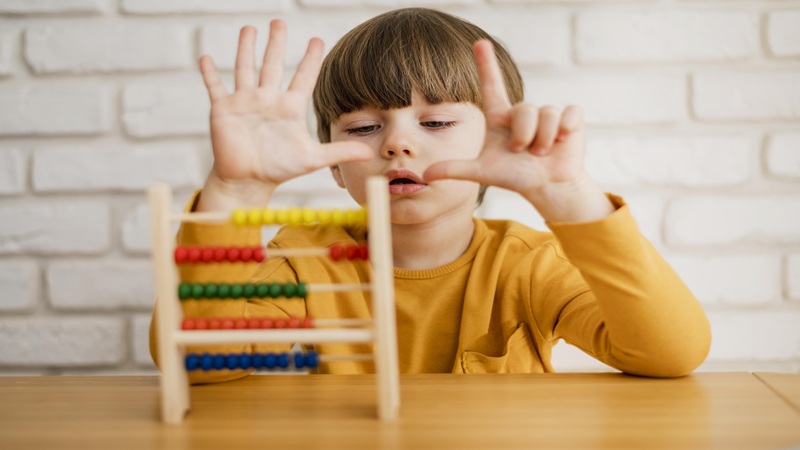
Here’s what a lot of after-school math sessions actually look like: a worksheet, a resistant child, and an exasperated, concerned parent.
The session also includes a negotiation that somehow ends with everyone frustrated. And in the end, the kiddo is still not a fan of the subject, just like at the beginning of the session.
See, the question isn’t whether or not your child is good at math. It’s whether they are enjoying the process of learning math or not.
So what if the after-school math session had ten minutes of a math game your child actually wanted to play?
Would the experience and outcome be different? Let’s find out.
What Does the Research Say?
Recent studies show that number-based games build early math skills in children from preschool through second grade. Short, consistent, and focused sessions of game-based math practice, even just around ten minutes a day, produce measurable and lasting results in numeracy—from counting and number recognition to understanding quantities more easily.
In short, math games for kids help absorb concepts more effectively. The consistency paired with the enjoyment of gaming makes all the difference in your child’s learning. Studies have proven that a child who plays a math game for ten minutes every day will often outperform one who grinds through worksheets once a week. This is because every time they play the game, they’re practicing math concepts.
Why Math Games Work on Kids
Young children don’t learn well through repetition alone. They also need to learn through engagement. When a child is genuinely absorbed in something, their brain is actively making connections, which helps them remember data better. And with math games, the child’s retention rate is higher because they are engaged throughout the game and return to it again and again. Thus, they are practicing mathematical concepts regularly.
This is because a number puzzle gives immediate feedback. A counting challenge has stakes. A game that advances when the answer is right tells a child’s brain, “This is important, stay focused”. That’s a fundamentally different message from “complete row four.”
Besides, there’s another reason why games help children learn math better.
Math anxiety is real, and it starts early. When a child’s repeated experience with numbers involves pressure and correction, their relationship with math takes a hit. And it can last for years. But that’s not the case with math games for kids. With games, numbers stop feeling intimidating because they arrive wrapped in something genuinely enjoyable.
What Ten Minutes of Games Look Like
The ten-minute window is small but significant. It’s a consistent window of play with a clear mathematical purpose baked right in.
During those ten minutes, your child might match numbers to quantities, navigate a counting sequence, solve a shape puzzle, or work through a simple addition challenge in our fun game, Math Whiz.
The best part? The kid is not stressing about math. They’re thinking about winning.
We suggest scheduling this session right after a snack, before dinner, or as part of a morning routine. Why? Think about it. “After snack, we play” is a sentence a 4-year-old can easily remember. And it’s something for the tiny tot to look forward to every day.
What to Look for in Math Games for Kids
Most math games for kids are built for short, high-engagement learning. They are designed specifically for children aged 2–7, which means the challenges aren’t based on a rigid curriculum. Instead, they are calibrated to match your child’s learning pace. A toddler just getting familiar with numbers will encounter counting and number recognition in ways that feel like discovery.
An older preschooler gets introduced to simple patterns and quantity comparison through challenges that push them just far enough without tipping into frustration. The whole experience adapts quietly in the background, keeping your little gamer in that productive zone where learning stays fun. However, this is only possible if the math games you choose come with no ads, external links, or unwanted distractions. It should be ten focused minutes of play that builds mathematical foundations.
And because it never feels like work, the little ones keep coming back for more.
The Bigger Shift
What changes when math becomes something your child actually looks forward to? Their approach to handling difficulty changes. So, when a game challenge is hard, they try again. When they get something wrong, they adjust.
That instinct — try, fail, try differently — is the foundation of mathematical thinking.
So by encouraging your little one to play math games, you’re not just making them fill ten minutes of an afternoon with math because you have to. You’re shaping how they feel about numbers, problems, and effort itself. See more