
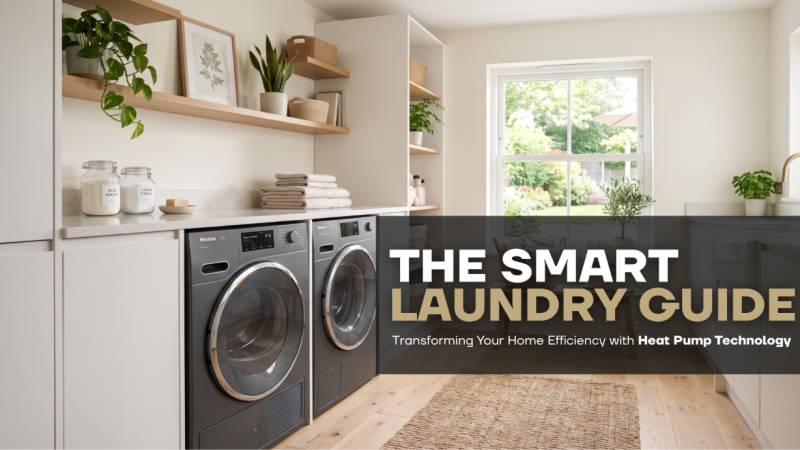
When managing a modern household, the laundry room represents one of the most resource-intensive zones in terms of both water consumption and electrical load. For families, energy-conscious homeowners, and sustainability advocates, selecting major appliances is no longer a simple matter of matching physical dimensions and upfront purchase prices. As utility rates fluctuate and environmental efficiency standards tighten across the globe, understanding the thermodynamic engineering inside your laundry appliances becomes essential to controlling long-term operational costs. When the time comes to upgrade a failing appliance or design a high-performance utility space, the decision to buy dryers online gives consumers a positive, highly effective opportunity to evaluate advanced configurations that match their specific home layout and resource goals. By directly comparing traditional vented technology, intermediate condenser configurations, and next-generation closed-loop heat pump systems, households can make a strategic investment that preserves their wardrobe while significantly reducing their seasonal power footprint.
The secret to maximizing the return on your appliance investment relies on moving past a short-term focus on upfront retail cost to embrace a comprehensive lifetime cost-of-ownership analysis. While different clothes dryer variations look almost identical on a retail showroom floor, their internal mechanical designs process air, moisture, and electrical energy in completely opposite ways.
The Thermodynamics of Open-Loop Vented Dryers
To fully appreciate the operational leaps achieved by modern laundry technology, it is necessary to examine the physical engineering that defines the traditional vented clothes dryer. These time-tested units operate on an open-loop thermodynamic model, which relies on a continuous, linear intake and exhaustion of air.
When a vented dryer begins its cycle, it draws ambient room air from your laundry space into its internal chassis. This air is pulled directly across a high-wattage electrical resistance heating element, rapidly elevating the air temperature to anywhere between 70 and 80 degrees Celsius. This superheated, dry air is then forced into the spinning drum, where it tumbles through wet fabrics, causing moisture to rapidly evaporate from the textiles into the air stream.
However, once this air becomes saturated with moisture, the open-loop system must discard it entirely. The appliance utilizes a powerful fan to force the hot, humid, lint-laden air out of the drum and through a dedicated exhaust pipe. This setup introduces several significant installation requirements and economic trade-offs:
- Structural Ducting Dependencies: Because the exhausted air is thick with moisture, it cannot simply be dumped back into the laundry room without causing rapid mold growth, wood rot, and structural drywall damage. The unit must be physically connected to an external wall duct, or placed adjacent to an open window via a flexible hose. This requirement significantly restricts where you can place the machine within a home.
- Secondary HVAC Strain: By constantly exhausting massive volumes of air out of the building, a vented dryer creates a localized negative pressure zone inside your home. This forces your primary home heating or air conditioning system to work significantly harder as it struggles to condition the drafty outdoor air that is pulled into the house to replace the exhausted laundry air.
- High Electrical Intensity: Because the machine continuously draws in cool room air, the high-wattage electrical element must remain powered on almost constantly throughout the cycle to heat the new air from scratch, resulting in maximum energy consumption.
Intermediate Closed-Loop Mechanics: Condenser Dryers
Condenser dryers represent an engineering transition step between open-loop vented appliances and high-efficiency heat pump systems. Designed primarily to solve the physical constraints of structural wall ducting, condenser units utilize a partially closed-loop architecture that manages moisture internally.
Instead of discarding humid air through an external wall pipe, a condenser dryer reroutes the saturated air stream away from the drum and down through an internal heat exchanger. This exchanger typically uses ambient room air flowing in a separate channel to cool the hot, moist air from the drum. As the temperature of the drum air drops below its dew point, the suspended moisture condenses out of the air column, turning back into liquid water.
This extracted water is either pumped into an integrated plastic collection tank that the user must manually empty after every cycle, or routed directly down a standard washing machine drainpipe. The remaining dry air is then reheated by a traditional electrical element and pushed back into the tumbling drum to continue the drying process.
While condenser models successfully eliminate the need for external wall holes, making them highly popular for high-rise apartments and small rental units, they still rely on high-wattage resistance elements to generate heat. Consequently, their baseline energy consumption remains relatively high, and they tend to vent significant amounts of ambient heat directly into the surrounding room, noticeably warming up small laundry spaces during operation.
Next-Generation Closed-Loop Technology: Heat Pump Systems
The introduction of heat pump clothes dryers, popularized by advanced manufacturers like LG and Panasonic, represents a major paradigm shift in home laundry mechanics. Rather than generating raw heat through energy-intensive electrical resistance elements, a heat pump dryer functions as a specialized, self-contained refrigeration and heating system working in a perpetual, highly optimized closed loop.
The core mechanical system consists of a closed compressor loop containing a specialized refrigerant fluid, paired with two separate sets of thermal coils: an evaporator coil and a condenser coil. The thermodynamic journey of a single air charge inside a heat pump dryer follows a highly efficient path:
- Moisture Extraction: Saturated, warm air from the tumbling drum is pulled across the cold evaporator coils. The sudden temperature drop causes the moisture to rapidly condense out of the air column into a collection tray, leaving the air dry but cold.
- Energy Recycling: Instead of wasting the thermal energy extracted during the condensation phase, the compressor pumps the pressurized refrigerant over to the condenser coils. The cold, dry air is forced directly across these hot condenser coils, absorbing the recycled heat energy before it enters the drum again.
- Low-Temperature Tumble: The reheated dry air is pushed back into the drum at a highly controlled temperature, typically averaging a gentle 50 degrees Celsius. This cycle repeats continuously, reusing the exact same air charge over and over without ever needing to vent air into your home or pull new air from the room.
By recycling existing thermal energy rather than generating heat from scratch, a heat pump dryer uses up to 50% less electricity than a standard vented model. Furthermore, because the drying temperature is significantly lower, it eliminates the thermal shock that causes delicate clothing fibers to shrink, warp, or become brittle over time, effectively extending the lifespan of your wardrobe.
Operational Analysis: Vented, Condenser, and Heat Pump Technologies
Reviewing the specific structural properties, mechanical behaviors, and long-term operating costs between these three distinct dryer types highlights why matching your machine to your household infrastructure is critical for long-term satisfaction.
| Feature Metric | Open-Loop Vented Dryers | Intermediate Condenser Dryers | Advanced Heat Pump Dryers |
| Air Circuit Style | Open-loop (continuous exhaust) | Closed-loop (internal cooling) | Closed-loop (refrigerant loop) |
| Heating Mechanism | Electrical resistance element | Electrical resistance element | Compressor and thermal coils |
| Average Drying Temp | High (70°C to 80°C) | High (65°C to 75°C) | Low and Gentle (approx 50°C) |
| Wall Vent Required | Yes (mandatory external duct) | No (condenses into tank/drain) | No (condenses into tank/drain) |
| Average Energy Savings | Baseline (highest power consumption) | Minimal savings over vented | Maximum (up to 50% lower draw) |
| Fabric Wear Profile | Accelerated due to high heat | Moderate wear over time | Minimal (ideal for silk, wool, activewear) |
By evaluating this direct mechanical matrix, head-of-household decision-makers can easily see that while heat pump models demand a higher initial retail investment, they deliver unmatched operational savings and placement flexibility.
Financial Engineering: Calculating Lifetime Running Costs
For budget planners and sustainability advocates, evaluating the real value of a heat pump dryer requires looking at the total cost of ownership over a ten-year operational lifecycle. Because a clothes dryer is one of the highest wattage draw appliances in a home, small differences in energy efficiency quickly add up to major shifts in household wealth.
Consider a typical Australian family that runs four to five loads of laundry per week. A standard vented dryer with a low energy rating will often pull between 4.5 and 5.5 kilowatt-hours of electricity per single load. At average residential electricity tariff rates, running this machine can easily cost a household hundreds of dollars every single year in direct energy usage.
In contrast, a next-generation heat pump dryer equipped with an advanced inverter compressor often pulls as little as 1.5 to 2.1 kilowatt-hours to process the exact same size load of damp laundry. When multiplied across hundreds of cycles over a decade of continuous service, the heat pump model completely offsets its higher initial purchase price within the first few years of operation. Every year after that point represents pure financial savings back into the household budget, while simultaneously reducing your home’s carbon footprint and lowering localized strain on the electrical grid during peak winter and summer billing seasons.
Conclusion: Investing in an Efficient Laundry Ecosystem
Deciding on the permanent infrastructure for your home’s laundry routine is a long-term choice that directly shapes your weekly utility bills, garment longevity, and spatial comfort. Continuing to rely on outdated, high-heat vented appliances without proper external ducting leaves your home exposed to hidden structural mold risks, excessive electrical bills, and unnecessary fabric damage.
By taking the time to analyze your family’s weekly washing volume and layout limits, you can easily deploy a strategic appliance setup that stands the test of time. Traditional vented models remain a viable, low-cost solution for households with pre-existing external wall vents who only use their dryer occasionally during deep winter emergencies. However, for modern families seeking maximum energy independence, structural freedom, and gentle fabric preservation, investing in a closed-loop heat pump dryer is the ultimate choice for a sustainable, high-performance household. Take complete command of your residential utility footprint today, retire old heating elements for good, and select a modern laundry solution that keeps your budget balanced and your peace of mind fully protected. See more