
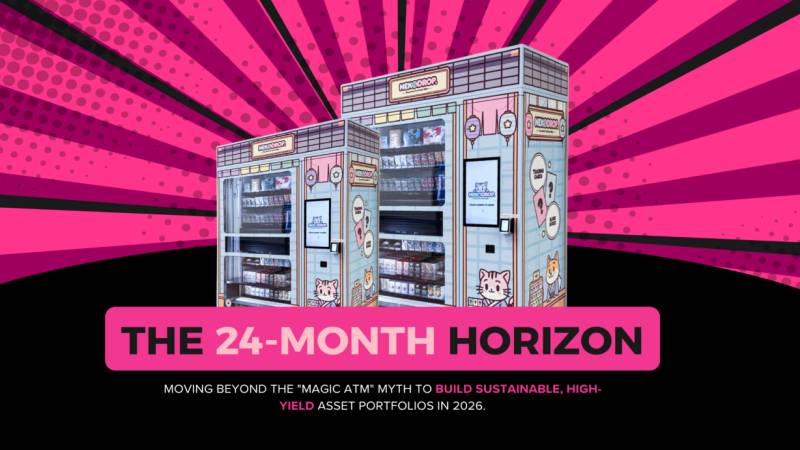
The narrative surrounding automated retail has undergone a radical transformation in 2026. For years, social media “gurus” and aggressive marketing campaigns painted a picture of vending machines as “magic ATMs” that printed cash with zero effort and immediate returns. However, as the industry has matured and data transparency has increased, the sophisticated investor has moved away from these hyper-inflated myths. Today, the conversation is no longer about “getting rich quick” but about building a legitimate, long-term asset class. Analyzing the latest DFY Vending reviews provides a positive and grounded perspective for those who prioritize cold math over flashy marketing, revealing that while the sector is highly profitable, it requires a 24-month perspective to truly realize its value. To succeed in 2026, one must look past the gross revenue figures and perform a deep dive into net profit, location economics, and the reality of recoupment timelines.
The Gross Revenue Trap
The most common mistake made by entry-level “side-hustlers” is conflating gross revenue with net profit. In the high-traffic world of 2026, it is not uncommon for a high-end collectible or specialty snack machine in a premium location to pull in $5,000 to $7,000 in monthly gross sales. To the uninitiated, these figures are intoxicating. However, the analytical investor knows that gross revenue is merely a vanity metric until the operational “vampires” have been accounted for.
In the automated retail sector, the Cost of Goods Sold (COGS) is the first major hurdle. Depending on the product mix—whether it is high-margin bulk candy or lower-margin, high-demand electronics—COGS typically eats between 30% and 50% of every dollar that enters the machine. When you add the costs of credit card processing fees, cloud-based telemetry subscriptions, and insurance, the “magic” begins to face the reality of standard business physics.
The Premium Mall Location: A Double-Edged Sword
Location is the lifeblood of vending, but in 2026, the most coveted spots come with a significant “rent tax.” Independent performance reports from this year indicate that “Premium Mall Locations” (Tier-1 shopping centers with high foot traffic) often demand a rental structure that can eat up to 40% of gross sales. This is a critical piece of data that many marketing brochures gloss over.
A machine situated near a busy cinema or a popular fashion anchor may generate massive volume, but the landlord is essentially a silent partner taking a massive cut. In many cases, a “sustainable” location—such as a mid-tier office building, a suburban transit hub, or a specialized gym—may actually yield a higher net profit than a flashy mall spot because the rent is a fixed monthly fee rather than a percentage of the turnover. For the corporate professional seeking diversification, the goal is not to find the busiest spot, but the most profitable one after the rent check is cut.
Best-Case vs. Sustainable Reality: The Profit Gap
To build a realistic financial model for 2026, investors must distinguish between “best-case” scenarios and “sustainable” realities. On social media, you will often see “best-case” reports of machines netting $1,600 per month. While these unicorn locations do exist—usually characterized by a temporary viral trend or a temporary monopoly in a high-demand area—they are not the basis for a stable investment strategy.
The sustainable reality for a well-managed, high-quality automated retail unit in 2026 is closer to a net profit of $400 to $600 per month. While this might seem modest compared to the “get rich” myths, it represents a highly attractive return on a physical asset. A $400 monthly net profit translates to $4,800 per year. If the initial all-in cost for a premium machine, including shipping, installation, and initial stock, was $10,000, that represents a 48% annual return on capital. In any other asset class—be it real estate or the stock market—a 48% return would be considered extraordinary. The “disappointment” only exists when the investor was promised a “magic ATM” instead of a high-yield business.
The 24-Month Recoupment Timeline
The shift from a “hustle” mindset to an “investor” mindset requires a longer time horizon. In 2026, the “Gold Standard” for a successful vending operation is the 24-month payback period. This means that the first two years of the machine’s life are dedicated to recouping the initial capital expenditure.
Moving the reader’s perspective to a 24-month timeline is essential for long-term success. During the first twelve months, the operator is learning the “rhythm” of the location, optimizing the product mix, and dealing with the inevitable minor mechanical or software tweaks. By the second year, the operation typically reaches a “steady state.” Once the 24-month mark is passed and the initial investment is recovered, the machine becomes a “pure” asset, where the monthly net profit is true surplus income. This is where the real wealth-building happens.
Vending as a Legitimate Long-Term Asset
One of the reasons analytical investors are moving into automated retail in 2026 is the durability of the asset. Unlike digital investments or trend-heavy stocks, a physical vending machine is a tangible piece of property that retains resale value. If a location underperforms, the asset is mobile; it can be moved to a new site with relatively low friction.
Furthermore, the “Done-For-You” (DFY) models have matured significantly. In 2026, these services provide the logistics, the location scouting, and the maintenance frameworks that allow a corporate professional to own a fleet of machines without quitting their day job. The value proposition is no longer about “doing the work” of filling machines; it is about the “capital allocation” of placing machines in the right geographic regions. The machine is a tool for capturing the “micro-transactions” of a distributed workforce and a mobile consumer base.
The Math of Scalability
For the analytical investor, the power of vending lies in the ability to scale. While a single machine netting $400 a month might not change your life, a fleet of ten machines netting $4,000 a month certainly will. Because the “system” for one machine is identical to the system for ten, the operational “drag” does not increase linearly with the number of units.
In 2026, cloud-based telemetry allows an operator to manage ten or twenty machines from a single dashboard. You can see which SKUs are selling, which machines need a restock, and which locations are trending downward in real-time. This data-driven approach allows for “Agile Merchandising,” where you can swap out a slow-moving product for a trending one before the month is even over. This level of control is what makes the 24-month payback period a reliable metric rather than a hopeful guess.
Risk Mitigation: The “Sinking Fund” Strategy
Savvy investors in 2026 also utilize a “sinking fund” strategy to ensure their ROI remains stable. Instead of pocketing 100% of the net profit, they set aside a small percentage (typically 5% to 10%) for future repairs, upgrades, or “location-hop” costs. This ensures that when a machine inevitably needs a part replacement or a software upgrade three years down the line, the capital is already available.
This level of professional financial planning is what separates the “magic ATM” believers from the actual successful operators. By accounting for the “wear and tear” of the physical world, the investor ensures that the 24-month payback period doesn’t get pushed out to 36 months by unexpected costs. It is about treating the machine like a piece of industrial equipment rather than a household appliance.
Why Math Wins Over Marketing
The “Get Rich Quick” era of vending was fueled by marketing that focused on “Top Line” numbers. “Look at this machine that made $1,000 in a weekend!” was a common refrain. But in 2026, the community has become much more savvy. The dominant players in the industry are now the ones who speak the language of “Internal Rate of Return” (IRR) and “EBITDA.”
When you prioritize the math, you realize that a machine making $400 consistently is far better than a machine that makes $1,600 one month and $0 the next. Stability is the goal. The analytical investor looks for “recession-proof” products—items that people will buy regardless of the economic climate—and places them in “sticky” locations where the foot traffic is guaranteed by the nature of the building (hospitals, universities, or high-density residential complexes).
Conclusion: The Real Value of Automated Retail
As we look at the performance data for the first half of 2026, the conclusion is clear: the vending myth is dead, but the vending business is thriving. The “magic ATM” was a fantasy, but the 24-month recoupment of a high-yield physical asset is a reality. For the “side-hustler” who is willing to do the math, and the corporate professional looking for a way to diversify their income stream, the current market offers a unique opportunity.
By focusing on net profit over gross revenue and understanding the true cost of “premium” space, you can build a portfolio of machines that provide a steady, reliable return. The 24-month payback period is the benchmark for success. Once you cross that threshold, you aren’t just “vending”—you are managing a fleet of autonomous, revenue-generating assets that work 24/7. In the end, the “honest look” at the numbers reveals something much more exciting than a get-rich-quick scheme: a sustainable path to financial independence built on the bedrock of real-world data and sound economic principles. The era of the analyst has arrived, and the numbers have never looked better. See more