
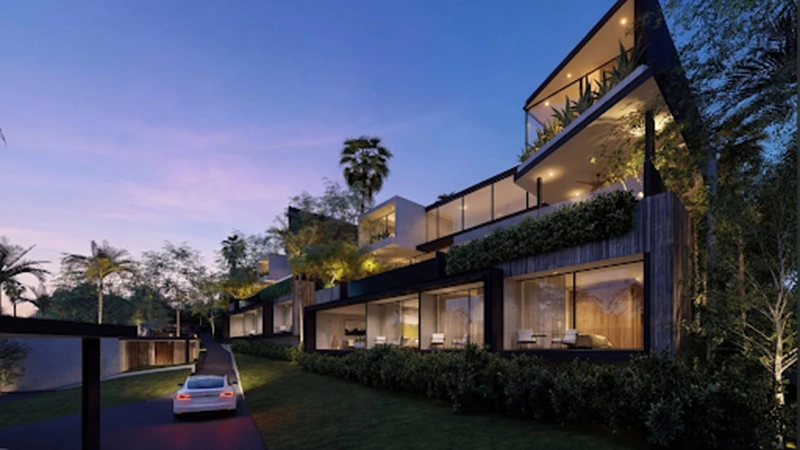
There is a pattern we see repeatedly in residential projects. The architect finishes the building. Months later, an interior designer comes in. Two separate briefs, two separate visions, one home trying to hold them both together.
The result is rarely a disaster. But it is rarely as good as it could have been. Something feels slightly off — and most clients cannot explain why.
This is the gap we have spent years working to close. At Adoani Studio, architecture and interior design are never two phases. They are one process, from the first sketch to the final detail.
The Real Problem with Separating Them
Most people think of architecture as the shell and interiors as what fills it afterwards. It is an understandable way to think — but it is also why so many homes, even expensive and well-intentioned ones, feel disconnected.
The decisions that define a great interior are not made at the furniture stage. They are made at the very beginning — in the orientation of the building, the ceiling height, the position of an opening, and the way natural light enters a room in the morning.
By the time an interior designer walks into a completed shell, those decisions are already fixed. Often made without the interior in mind at all.
What Gets Lost in the Gap
When architecture and interiors are handled separately, the same problems appear every time. We have seen them across projects of every scale and budget.
Proportion
Rooms designed without furniture in mind produce awkward layouts that no interior design can fully rescue. The space looks right on paper, but feels wrong to live in.
Light
Windows positioned for the exterior elevation — not for how they will illuminate the interior. The result is either too much light in the wrong places or too little where it is needed most.
Material Continuity
Exterior and interior finishes selected independently create a disconnect at every threshold. The home feels like it changes identity when you move from outside to inside.
Built-In Elements
Joinery, cabinetry, and fixed furniture designed late in the process feel inserted into the space rather than belonging to it.
Spatial Flow
The sequence from one room to the next is an architectural decision — but one that defines the entire interior experience. When it is not considered together from the start, the home never quite flows naturally.
Why This Matters Even More in Bali
In many climates, separating architecture and interiors is a manageable compromise. In Bali, it simply does not work.
Its relationship to the outside defines Architecture Bali. The covered terrace, the semi-open living pavilion, the pool that reads as a continuation of the interior — these exist in the space between architecture and interior design. They are structural decisions with profound interior consequences.
When we design residential projects here as a Bali architecture firm, we are constantly navigating this boundary. And it cannot be navigated by two separate teams working in sequence.
Every Architectural Decision Has an Interior Consequence
- The depth of an overhang determines the quality of light inside the living room
- The height of a parapet determines whether the pool is visible from the sofa
- The width of a threshold determines how the interior connects to the garden
- The orientation of the building determines when and how natural light enters every space
These decisions cannot be undone once the building is complete. This is why, in our work, they are never made without the interior already in mind.
How We Work — One Process, Not Two
From the first sketch of any project, we are thinking about both simultaneously. The architectural form and the interior experience. The exterior material and the interior material it will meet. The ceiling height and the furniture scale it needs to support.
At Adoani Studio, these are never separate questions. They are the same question, explored together from day one.
Proportions Designed for Living
When we design minimalist spaces, we think about furniture layout before wall positions are finalised. Not because furniture drives the architecture, but because the architecture should make honest sense for how the space will actually be used.
- A living room needs to know where the primary seating sits before the window position is right
- A bedroom needs to resolve the relationship between the bed and the morning light before the ceiling height is decided
- A bathroom needs to understand its relationship to the view before the opening is placed
When these connections are made early in the process, the finished space has a quality of inevitability. Everything is where it should be. Nothing feels imposed.
A Single Material Logic
In our work across interior design Bali, material selection is never two separate decisions — one for the exterior and one for the interior. It is one decision, applied with variation across the whole home.
- Stone used raw and textured on the exterior reappears honed and refined on the interior floor
- Timber that reads as a structural screen outside becomes ceiling cladding or joinery inside
- Concrete exposed and honest on the facade becomes polished and precise as an interior surface
- Floor materials continue uninterrupted from the living room through to the terrace
This is not repetition. It is continuity. And continuity is what makes a home feel conceived as a whole rather than assembled in parts.
Light Resolved as One System
Lighting is where the disconnection between architecture and interiors causes the most damage — and where our integrated approach produces the most visible results.
When we resolve both together, the approach is entirely different:
- The skylight is positioned to create a specific quality of light at a specific time of day
- The window is placed to graze a wall surface and give the room depth
- The architectural decisions and interior decisions amplify each other, not compensate for each other
There is no moment in our process where lighting is considered for the first time. It is part of the conversation from the beginning.
The Interior as an Extension of the Architecture
There is a distinction we return to often in our own thinking: the interior should feel like it grew from the architecture, not like it was placed inside it.
This quality is felt immediately in spaces where it has been achieved. Built-in elements align with the structural logic of the building. Furniture proportions respond to the ceiling height. The view framed by the window is reflected in the arrangement of the room. Everything belongs to the same idea.
How We Handle Built-In Elements
In our process, joinery, shelving, and kitchen design are not furniture decisions made at the end of a project. They are spatial elements designed as part of the architecture itself.
- A joinery wall does not sit in a room — it completes the room
- A bathroom is not a box inserted into a floor plan — it is a considered space with its own relationship to light and material
- A staircase is not a circulation requirement — it is an architectural moment in its own right
When built-in elements are designed this way from the beginning, the interior never reads as an afterthought. It reads as part of the architecture — because it is.
What Our Clients Experience
When architecture and interior design are genuinely integrated — as they are in every project we take on, clients feel it the moment they walk in. Even when they cannot name exactly what is different.
- Spaces flow without effort from one to the next
- Light arrives where it is needed without feeling accidental
- Materials feel coherent without feeling repetitive
- Indoor and outdoor areas read as one continuous environment
- The home feels made for them — not assembled from separate decisions by separate people
This is what we work toward at Adoani Studio on every single project. Whether it is a large residential villa, a boutique development, or a focused interior design commission in Bali, the architecture and the interior are always one conversation.
They always have been. And for us, that is the only way to work.